
Overview
At Lymm High School, we believe that every young person deserves an education that prepares them not only for examinations, but for life beyond school. Alongside academic success, our Personal Development curriculum equips students with the knowledge, skills and confidence to make informed decisions, build healthy relationships, keep themselves safe and become responsible, respectful and resilient members of society.
Personal Development is delivered primarily through our Personal, Social, Health and Economic (PSHE) curriculum, known at Lymm High School as the Life Programme. It is designed to help students develop the knowledge, understanding and character needed to thrive in modern Britain and make positive contributions to their communities.
Our Values and Ethos state:
“We are a high performing comprehensive school with a proud tradition of service to our community for over 400 years.”
In keeping with this tradition, we strive to ensure every student:
- achieves their full potential;
- enjoys learning and becomes an independent lifelong learner;
- becomes a socially responsible citizen who contributes positively to their community;
- develops into a confident, resilient and compassionate individual.
Our Life Programme
PSHE education is a vital part of every student’s education. Through our Life Programme, students develop the knowledge, understanding and skills needed to stay healthy, safe and prepared for adult life.
Our curriculum is carefully sequenced from Year 7 through to Sixth Form, enabling students to revisit key themes as they mature and encounter new experiences.
PSHE is delivered through:
- Weekly Form Time sessions.
- Fortnightly 45-minute curriculum lessons.
- Assemblies.
- Drop-down days.
- Workshops and presentations from carefully selected external speakers.
- Cross-curricular learning where appropriate.
Lessons are planned by specialist staff, quality assured and regularly reviewed to ensure that learning remains accurate, relevant and responsive to the needs of our students. Our curriculum is inclusive and designed to meet the needs of all learners.
Curriculum overviews for each year group can be found below.
Relationships, Sex and Health Education (RSHE)
Relationships, Sex and Health Education (RSHE) forms a statutory part of the curriculum and is delivered in an age-appropriate, inclusive and evidence-informed manner.
Our curriculum supports students to:
- develop healthy, respectful relationships;
- understand consent and personal boundaries;
- recognise abuse, exploitation and unhealthy behaviours;
- develop positive physical and mental wellbeing;
- understand online safety and digital citizenship;
- appreciate diversity and challenge discrimination;
- make informed and responsible decisions that keep themselves and others safe.
We recognise that parents and carers are the primary educators of their children and aim to complement the important conversations taking place at home through factual, balanced and safeguarding-focused education.
Safeguarding, Online Safety and Prevent
Our Personal Development curriculum plays a vital role in safeguarding our students.
Through the Life Programme, students learn how to recognise and respond to a wide range of safeguarding issues, including:
- healthy and unhealthy relationships;
- consent;
- child sexual exploitation and criminal exploitation;
- county lines;
- knife crime;
- substance misuse;
- financial exploitation and scams;
- mental health and emotional wellbeing;
- online abuse and image-based abuse;
- cyberbullying.
Recognising the rapidly changing digital world, students also learn about misinformation, disinformation, deepfakes, artificial intelligence, digital footprints, sextortion and responsible use of technology, enabling them to become safe and informed digital citizens.
The curriculum also supports the school’s statutory Prevent Duty by developing students’ critical thinking, media literacy and resilience to harmful influences. Students learn how extremist groups and harmful online content can manipulate vulnerable individuals and are encouraged to question information critically, seek reliable evidence and know how to access support if they have concerns.
British Values
Our curriculum actively promotes the Fundamental British Values of:
- Democracy;
- The Rule of Law;
- Individual Liberty;
- Mutual Respect;
- Respect and Tolerance for people of different faiths, beliefs and backgrounds.
These values are embedded throughout the Life Programme, assemblies, student leadership opportunities, educational visits and wider school life, helping students become active, informed and respectful citizens.
Religion, Philosophy and Ethics (RPE)
We value the diversity of beliefs, cultures and backgrounds within our school community and believe that understanding different perspectives is essential in preparing students for life in modern Britain.
All students study Religion, Philosophy and Ethics (RPE) throughout Key Stage 4 and Key Stage 5. The curriculum explores a wide range of religious and non-religious worldviews alongside contemporary ethical and philosophical issues, encouraging students to engage with different perspectives through curiosity, respect and open-minded discussion.
RPE develops valuable lifelong skills including critical thinking, evaluation of evidence, respectful debate, ethical reasoning, empathy, communication and the ability to construct balanced, well-reasoned arguments. These skills prepare students to participate confidently in a diverse and democratic society while fostering respect for others and an appreciation of different beliefs and values.
Students also benefit from assemblies, visiting speakers and strong links with local faith communities, providing opportunities to engage with different perspectives and deepen their understanding of the diverse world in which they live.
Our Curriculum Framework
Our Personal Development curriculum is informed by national statutory guidance and recognised best practice to ensure students receive a broad, balanced and relevant education that prepares them for life in modern Britain.
Our provision is planned and regularly reviewed using guidance including:
- Department for Education statutory guidance for Relationships, Sex and Health Education (RSHE);
- The PSHE Association Programme of Study;
- Keeping Children Safe in Education (KCSIE);
- Prevent Duty Guidance;
- The Equality Act 2010;
- Fundamental British Values guidance;
- Character Education Framework;
- Careers guidance and the Gatsby Benchmarks;
- Local safeguarding priorities where appropriate.
Alongside these national frameworks, we continually review our curriculum to respond to emerging safeguarding concerns, developments in technology, current affairs and the changing needs of our students. Student voice, parent feedback and local context all contribute to shaping our curriculum.
Keeping Parents and Carers informed
We believe that parents and carers are partners in their child’s education.
To support these conversations at home, fortnightly updates about our PSHE curriculum are shared through the Parent Bulletin, alongside additional guidance where appropriate. Information about Drop Down Days, visiting speakers and workshops are also shared over Class Charts.
Right to Request Withdrawal from Sex Education
Parents have the right to request that their child is withdrawn from some or all of the sex education delivered as part of Relationships, Sex and Health Education (RSHE) that falls outside of the statutory National Curriculum for Science.
Parents cannot withdraw their child from:
- Relationships Education;
- Health Education;
- National Curriculum Science;
- Safeguarding content that schools are legally required to teach.
Parents wishing to request withdrawal should contact the Headteacher in writing. A meeting will then be arranged to discuss the request, explain the curriculum content and consider the child’s needs before a decision is made in accordance with Department for Education statutory guidance.
Students who are withdrawn from sex education lessons will be provided with appropriate supervised learning during those sessions.
Further information can be found in:
-
Department for Education – Relationships Education, Relationships and Sex Education and Health Education guidance
-
Lymm High School’s Relationships and Sex Education Policy.
Through our Personal Development curriculum, we aim to ensure that every student leaves Lymm High School as a knowledgeable, confident, compassionate and resilient young adult, equipped with the character, skills and understanding needed to flourish in higher education, the workplace and modern society.
Please click here to see a visual overview of the KS3 and KS4 Life Programme.
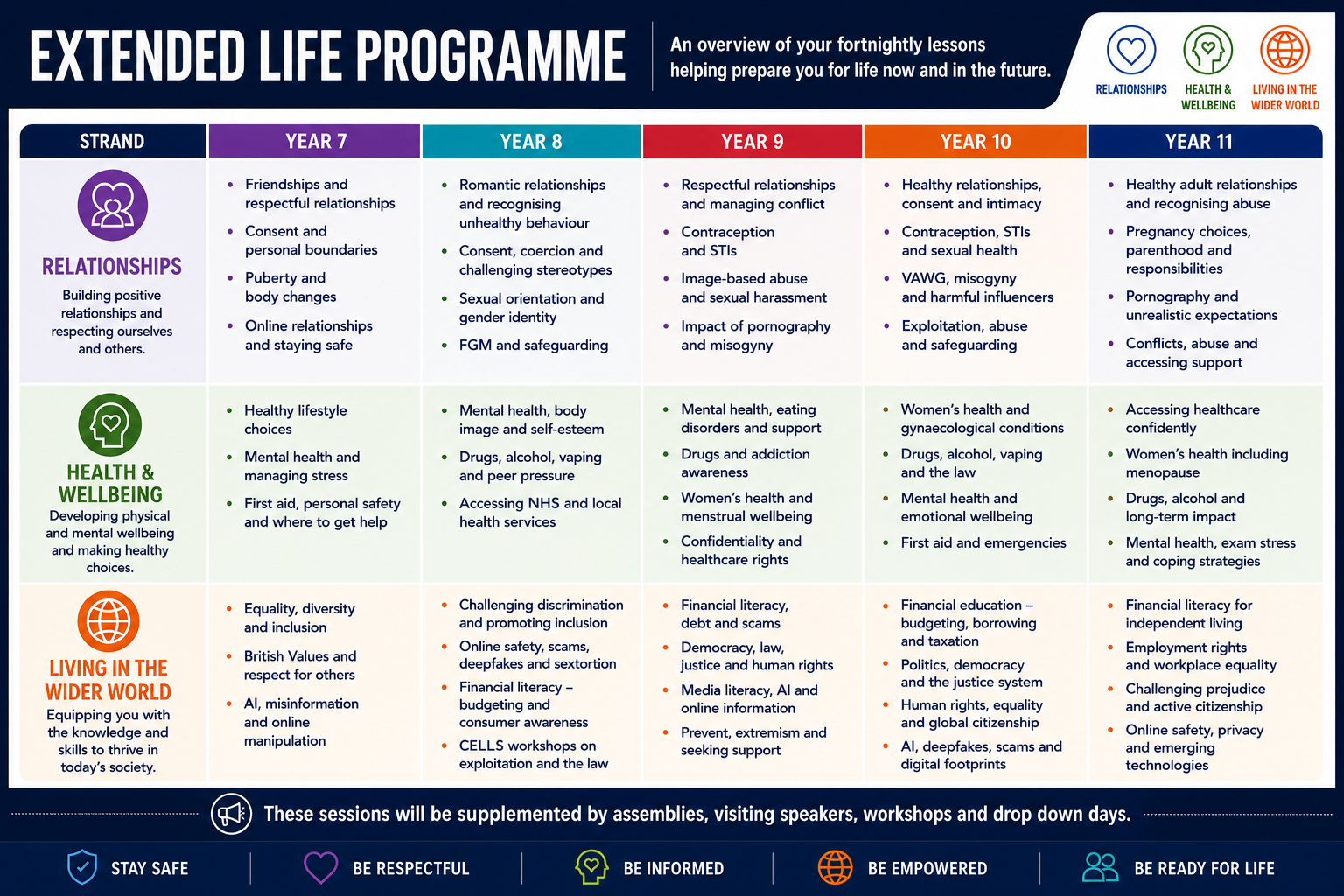
Through PSHE, students develop the knowledge, skills and personal qualities needed to lead safe, healthy and fulfilling lives.
The curriculum encourages students to think critically, weigh evidence, evaluate different viewpoints and make informed decisions. Students learn to communicate effectively, manage risk, solve problems and demonstrate empathy, resilience and respect for others.
Core Themes Across All Year Groups
Our PSHE curriculum is built around three overarching strands.
- Relationships
Students develop the knowledge and skills needed to build healthy friendships and relationships, understand consent and personal boundaries, recognise unhealthy or abusive behaviours and know how to access support when needed.
- Health and Wellbeing
Students learn how to look after their physical and mental health, manage emotions, reduce risk, make healthy lifestyle choices and develop resilience throughout adolescence.
- Living in the Wider World
Students explore equality (and equality laws), British Values, careers, financial education, digital citizenship, media literacy, democracy, the law and their responsibilities as active members of society.
Year 7
During Year 7, students focus on successfully transitioning into secondary school whilst developing confidence, independence and healthy relationships.
Relationships, Sex and Health Education (RSHE)
- Healthy friendships, communication skills and recognising healthy and unhealthy relationships.
- Understanding consent, personal boundaries and respecting others.
- Puberty, emotional changes, body confidence and personal hygiene.
- Menstrual wellbeing, including the menstrual cycle, recognising when periods are not normal, reducing stigma and knowing when and how to seek medical advice.
- Family relationships, managing change and resolving conflict.
- Online relationships, cyberbullying, digital footprints and responsible online behaviour.
Health and Wellbeing
- Healthy lifestyle choices, including vaping, smoking, alcohol, caffeine, nutrition and sleep.
- Mental health awareness, emotional wellbeing and strategies for managing stress.
- First aid, personal safety, emergency procedures and accessing support.
Living in the Wider World
- Equality, diversity, inclusion and the Equality Act 2010.
- British Values, respect and challenging prejudice and discrimination.
- Artificial intelligence, misinformation and recognising online manipulation.
Year 8
As students become more independent, Year 8 explores increasingly complex relationships, safeguarding issues and life skills.
Relationships, Sex and Health Education (RSHE)
- Healthy romantic relationships and recognising unhealthy or abusive behaviours.
- Consent, coercion, positive masculinity and challenging harmful gender stereotypes.
- Sexual orientation, gender identity and promoting inclusion and respect.
- Female Genital Mutilation (FGM), including the law, safeguarding and how to seek help.
- Family relationships and accessing support when home life becomes challenging.
Health and Wellbeing
- Mental health, body image, self-esteem and healthy coping strategies.
- Understanding how to access NHS and local health services confidentially.
- Drugs, alcohol, vaping and resisting peer pressure.
Living in the Wider World
- Challenging racism, sexism, ableism, homophobia, transphobia and other forms of discrimination.
- Online safety, including deepfakes, AI-generated content, AI chatbots, sextortion, scams, image-based abuse, fake online profiles, online algorithms, privacy and recognising online manipulation.
- Financial education, budgeting, spending, saving and consumer awareness.
- CELLS workshops exploring peer pressure, exploitation, joint enterprise and the real-life consequences of criminal behaviour.
Year 9
Year 9 prepares students for Key Stage 4 by developing greater independence and encouraging informed decision-making.
Relationships, Sex and Health Education (RSHE)
- Respectful relationships, managing conflict, healthy break-ups and ongoing consent.
- Sexual health, contraception and sexually transmitted infections (STIs).
- Patient confidentiality, young people’s healthcare rights and accessing healthcare, including GPs, pharmacies, NHS 111 and sexual health services.
- Women’s health, including age-appropriate learning about menstrual health, recognising abnormal symptoms and understanding that conditions such as endometriosis and polycystic ovary syndrome (PCOS) exist and when medical advice should be sought.
- The law relating to sharing intimate images, image-based abuse and sexual harassment.
- The impact of pornography, misogyny, harmful online influencers, incel culture and unrealistic online content on relationships, attitudes and expectations.
Health and Wellbeing
- Mental health, eating disorders, emotional wellbeing and accessing professional support.
- Drugs education, including cannabis, ketamine, alcohol, vaping, addiction and the law.
Living in the Wider World
- Financial literacy, borrowing, budgeting, debt, fraud and recognising financial scams.
- Democracy, the criminal justice system, human rights, British Values, active citizenship and understanding violence against women and girls (VAWG), including the importance of challenging sexism and misogyny.
- Media literacy, misinformation, disinformation, conspiracy theories, artificial intelligence, deepfakes, algorithms and evaluating online information critically.
- Prevent, radicalisation, extremism and how to seek support if concerns arise.
Please click here to see a visual overview of the KS3 and KS4 Life Programme.
Through PSHE in Years 10 and 11, students deepen and apply the knowledge, skills and personal qualities developed during Key Stage 3.
Our PSHE curriculum continues to build around three overarching strands.
- Relationships
Students develop the knowledge, confidence and skills to build healthy adult relationships, understand consent and the law, recognise abuse and exploitation, challenge harmful behaviours and know how to access support.
- Health and Wellbeing
Students develop the knowledge and skills needed to maintain positive physical and mental health, manage risk, access healthcare confidently and make informed lifestyle choices.
- Living in the Wider World
Students develop financial capability, careers awareness, digital literacy, media literacy, British Values and the knowledge needed to become active, informed citizens including the significance of the Equality Act 2010.
Year 10
Year 10 focuses on applying prior learning to real-life situations and preparing students to make safe, informed decisions as they become increasingly independent.
Relationships
- Healthy and respectful relationships, consent, personal boundaries and healthy intimacy.
- Contraception, sexually transmitted infections (STIs) and accessing confidential sexual health services.
- Pornography, image-based abuse and the law surrounding sharing intimate images.
- Violence against women and girls (VAWG), positive masculinity, misogyny, sexual harassment, harmful online influencers, incel culture and challenging sexist attitudes and behaviours.
- Exploitation, coercive control, abuse, safeguarding and how to access support.
Health and Wellbeing
- Women’s health, including age-appropriate learning about menstrual health, recognising abnormal symptoms and understanding that conditions such as endometriosis and polycystic ovary syndrome (PCOS) exist and when medical advice should be sought.
- Patient confidentiality, healthcare rights and accessing appropriate healthcare and support, including GPs, pharmacies, NHS 111, sexual health services and mental health services.
- Substance education, including cannabis, ketamine, alcohol, vaping, addiction and the legal consequences of substance misuse.
- Eating disorders, body image, mental health, emotional wellbeing and accessing professional support.
- Personal safety, first aid, emergency procedures and responding to alcohol poisoning and other medical emergencies.
Living in the Wider World
- Financial education, budgeting, borrowing, saving, taxation and making informed financial choices.
- Politics, Parliament, democracy, the criminal justice system and individual rights and responsibilities.
- Human rights, equality, diversity, global citizenship and international responsibility.
- Active citizenship, political extremism, radicalisation and the Prevent Duty.
- Artificial intelligence, AI chatbots, deepfakes, online scams, sextortion, digital footprints, algorithms, misinformation, disinformation and recognising online manipulation.
Year 11
In their final year of Key Stage 4, students prepare for post-16 education, employment and the responsibilities of adult life.
Relationships
- Healthy adult relationships, consent, healthy intimacy, coercion and recognising abusive or controlling relationships.
- Pregnancy choices, reproductive health, fertility, parenthood and the responsibilities of becoming a parent.
- Pornography, image-based abuse and the impact of unrealistic online content on relationships, expectations and behaviour.
- Managing conflict, recognising emotional, physical, sexual and online abuse, safeguarding and accessing appropriate support.
Health and Wellbeing
- Accessing healthcare confidently, including GPs, pharmacies, NHS 111, emergency services, sexual health services and mental health services, understanding when and how to seek medical advice, and knowing what support is available.
- Women’s health, including age-appropriate learning about menstrual health, recognising abnormal symptoms, understanding conditions such as endometriosis, polycystic ovary syndrome (PCOS) and menopause, and knowing when medical advice should be sought.
- Drugs, alcohol, vaping, addiction and the long-term impact of substance misuse.
- Mental health, anxiety, depression, self-harm, exam stress and healthy coping strategies.
Living in the Wider World
- Financial literacy, income, payslips, taxation, pensions, credit, debt, consumer rights, fraud awareness and preparing for independent living.
- Employment rights, workplace equality, discrimination, harassment and professional conduct.
- Challenging prejudice, discrimination, unconscious bias, equality, diversity, respect for others and acting as an active bystander.
- Positive role models, exploitation, county lines, gang culture and the legal concept of joint enterprise.
- Media literacy, conspiracy theories, misinformation, disinformation and evaluating online information critically.
- Online privacy, digital rights, artificial intelligence, emerging technologies and responding safely to online risks.
Key Stage 5 PSHE Curriculum
Please click here to see a visual overview of the KS5 Life Programme.
Through PSHE, Sixth Form students develop the knowledge, skills and personal qualities needed to thrive as young adults and prepare for life beyond Sixth Form.
Our PSHE programme is delivered through fortnightly tutor-led lessons, weekly tutor time, assemblies and external workshops. The curriculum equips students with the confidence to make informed decisions about relationships, health, careers and independent living. Students develop critical thinking, resilience, financial capability and the skills needed to navigate higher education, employment and adult responsibilities. Through discussion, debate and reflection, students explore a range of perspectives and learn to become active, responsible members of society.
Core Themes Across All Year Groups
Our Sixth Form PSHE curriculum is built around three overarching strands.
Relationships
Students deepen their understanding of healthy adult relationships, consent, sexual health, respect, equality and personal responsibility. They explore communication, managing conflict, recognising unhealthy behaviours and building positive relationships in a range of settings.
Health and Wellbeing
Students develop strategies to support their physical and mental wellbeing, build resilience, manage stress, make informed lifestyle choices and understand how and when to access professional support.
Living in the Wider World
Students prepare for adulthood through learning about careers, higher education, apprenticeships, employment rights, financial capability, politics, democracy, media literacy and independent living.
Year 12
Year 12 focuses on developing independence, resilience and the knowledge needed to make informed decisions as students begin planning for their future.
Relationships, Sex and Health Education (RSHE)
- Healthy relationships, intimacy, consent and respectful communication.
- Pregnancy, contraception, abortion and sexual health.
- Recognising and challenging sexual harassment and inappropriate behaviours.
- Managing inclusion, personal boundaries and respectful relationships.
- LGBTQIA+ inclusion, equality and understanding diverse identities.
Health and Wellbeing
- Building resilience, motivation and independence for Sixth Form study.
- Mental health, emotional wellbeing and developing a positive self-concept.
- Healthy lifestyles, nutrition, personal safety and managing risk.
- The impact of drugs, alcohol and substance misuse.
Living in the Wider World
- Financial education, including budgeting, saving, credit ratings and responsible borrowing.
- Media literacy, digital resilience and evaluating online information critically.
- Careers education, work experience, employability skills and workplace expectations.
- Employment rights, responsibilities, equality and inclusion in the workplace.
Year 13
As students prepare to leave school, Year 13 develops the confidence, knowledge and practical skills needed for university, apprenticeships, employment and independent adulthood.
Relationships, Sex and Health Education (RSHE)
- Building and maintaining healthy long-term relationships.
- Understanding yourself and others within relationships.
- Making new friendships and maintaining positive support networks.
- Equality, unconscious bias and promoting inclusion and respect.
Health and Wellbeing
- Managing stress during examinations and major life transitions.
- Nutrition, healthy lifestyles and maintaining wellbeing when living independently.
- First aid refresher and responding confidently in emergencies.
Living in the Wider World
- Political parties, democracy and active citizenship.
- Race, equality and challenging discrimination in modern Britain.
- Career pathways, university, apprenticeships and employment.
- Leaving home, managing finances, independent living and preparing for adult life.
In addition to tutor-led lessons, students’ learning is enhanced through assemblies, guest speakers and workshops delivered by specialist external organisations. These opportunities allow students to engage with current issues, hear from experts and develop the knowledge and skills needed to succeed beyond Sixth Form.